
THE SAN ANTONIO EXPRESS-NEWS
|






THE AUSTIN AMERICAN-STATESMAN
"Curtis was the afternoon's biggest hit in the arias How beautiful are the feet of them and I know that my Redeemer liveth".
THE ARKANSAS DEMOCRAT GAZETTE
"She has an extraordinary voice, a very musical voice. It effortlessly carries over an orchestra.
THE HERALD MAIL, Hagerstown, MD
"Curtis' singing is sweeter and darker. Her voice is beautiful no matter what and is informed by a touching sensitivity to the musical phrase. Her Lucia is more inward and vulnerable than Berneche's."
THE MILWAUKEE JOURNAL SENTINEL
"Houstonian Nancy Curtis soared authoritatively over the orchestra and chorus at the peaks of the Vaughan Williams."
THE HOUSTON CHRONICLE
"First, soprano Nancy Curtis blew them away when they were least expecting it with the evening's most powerful voice - the role she played, innocent Gilda, is usually sung by a less formidable soprano.... Curtis' cutting power was overwhelming, especially in the slightly stylized aria at the end of the second scene, after which the full house went wild. She has a very giving voice, even in the far reaches of the upper register. And she exercises great control, showing fine, artful phrasing and shaping decisions that show off her thick, rounded tone.... The duets between Honeysucker and Curtis were the ensemble highlight of the evening."
THE NEWS TRIBUNE, Tacoma, WA
""Nancy Curtis' lapidary soprano cut through the hall's acoustical flaws to produce passages of surpassing beauty."
THE AUSTIN AMERICAN-STATESMAN
"Curtis was particularly fierce, in the good sense of the word, in the opening work.... She continued to be the best of the quartet throughout the evening."
THE HOUSTON CHRONICLE
"Curtis is certainly aware of this fact, as the brilliance of her upper register is matched by an equally rich lower voice, too often absent in singers of her type. Her warm singing was sensitively accompanied.... Her execution of the short but virtuostic cadenza of the first movement was technically faultless and expressive. ...her final statements were the fullest and most thrilling.... Curtis enlivened both audience and orchestra with her rendering of the final movement's folk poem. ... Curtis' voice and face illustrated the child's view of heaven, full of character, yet never overreaching to histrionics. Her nuanced German, impeccable intonation, and warmly expressive singing ably illustrated the poem's idea that 'no music on earth can compare to ours'."
THE MORNING HERALD, Hagerstown, MD
"Brilliant and biting in the Café Momus tomfoolery of Act II, meltingly warm at Mimi's deathbed in Act IV, Curtis was a paragon of both physical and vocal acting."
THE SAN ANTONIO EXPRESS-NEWS
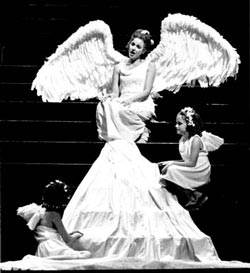
"Soprano Nancy Curtis, as Amore, had an appropriately sweet voice in her delivery of the character's radiant passages. She came across as an embodiment of easy grace despite carrying some downy angel wings on her back throughout the evening."
THE WASHINGTON POST
"Ford-Livene and Curtis were overall the best singers.... Curtis had the requisite spitfire personality and vocal technique to prance around confidently."
THE HOUSTON CHRONICLE
"Nancy Curtis and Vaclovas Daunoras were standouts. ... and Curtis' seemingly disembodied voice was one of the keenest delights in one of the opera's best realized scenes, the ceremony at the Temple of Vulcan."
THE TULSA WORLD